Monday, July 15, 2019

The Devil Is In The Details


Captain Hollon Richardson, Brigadier General Solomon Meredith’s aides de camp, at a postwar reunion with the 19th Indiana, while recounting the death of Sergeant Major Asa Blanchard and the woundings of Lieutenant Colonel William Dudley and Meredith, casually said that he retired the brigade to its second position on the field. That position is where the Iron Brigade monuments are located at Gettysburg along Meredith Avenue. In the general recounting of the battle, many historians have assumed that Meredith Avenue marks the original position of the brigade. It definitely is not.

 Position A. Following the defeat of Archer’s Brigade, Meredith ordered the Iron Brigade to retire to the eastern side of Willoughby Run. The attack, however had split the command. The 19th Indiana, the 7th Wisconsin, and the 2nd Wisconsin, respectively, took a position along the first ridge paralleling the creek. The ridge gradually rose from a marshy drainage on the southern end to a rocky ledge some 10 feet above the creek about 1000 feet to the north. The three regiments on the line extended north from the creek bottom for about 600 feet.

Position B. The 24th Michigan, the brigade’s largest regiment, cross Willoughby Run about 100 yards south of the 19th Indiana, facing east. Captain Richardson, on his own accord, according to one witness, ordered the regiment “front forward on the left battalion,” which Colonel Henry Morrow of the 24th verified in his afteraction report where he called the “left battalion” the “first battalion.” To change “front forward,” the regiment had to left wheel to face north. The maneuver placed the left of the regiment in the low ground and the right flank just above the crest where the right of Archer’s Brigade had lain.

Apparently, as I see the scenario unfolding, Meredith quickly realized that he could not successfully defend that position by leaving the brigade in a in a defilade from the west side of the creek. Nor could he let the 24th Michigan remain in the open ground below the woods. General Abner Doubleday, I Corps commanding, had arrived on the field and ordered Morrow to defend the woods at all costs because he considered it the key to the Federal defense of McPherson’s Ridge and the Union left. Meredith, therefore, chose the higher ridge, east of his current line, as the better position from which to hold Herbst Woods.

It probably was after 11:00 a.m. because the 150th Pennsylvania had arrived on the crest of the ridge, facing west with its left flank touching the northern side of the woods which provided Meredith with a point on which to anchor his brigade.

Position C. The small 2nd Wisconsin faced north at right angles to the Pennsylvanians. The 7th Wisconsin, following the contour of the ridge, connected with the left of the 2nd, creating the “little V” about which Colonel John Callis (7th Wisconsin) later wrote. Meredith plugged the 24th Michigan in between the 7th Wisconsin and the 19th Indiana, which had to refuse the right of the regiment up hill on a northwesterly front, to connect with the left wing of the 24th Michigan/ Colonels Dudley and Morrow repeatedly requested permission to retire ro the top of the hill rather than stay in the indefensible lower ground. They did so to no avail. Doubleday’s decision to keep them where they were cost a lot of good soldiers their lives.


Explaining this had explained why to many of the primary sources seem contradictory, when they actually are not. It also explains how the 19th Indiana and the 24th Michigan were shot to pieces.

Thursday, June 27, 2019

Chaos, Confusion, and Casualties


Once again, I have drifted off into miniature wargaming because I enjoy it and because it actually facilitates interpreting actual historical events. This year, I am finally getting back into wargaming with HMGS East. My grandson and I are attending Fall-In at the Valley Forge Convention Center where I will be delivering two presentations at the War College on Friday and Saturday at 10:00 a.m., entitled “Chaos, Confusion, and Casualties: Simulating a Civil War Battle in 54mm.

The gaming area will have 2 set up tables for the opposing armies and a gaming area 12 feet by 5 feet. Each side will have three brigades comprised of 5 regiments apiece with the sizes of the regiments ranging from 300 to 800 men, and two - 3 artillery section commanders.

The idea is for each player to be responsible for his/her own area of the field and work with the artillerists to gain domination of the adjoining fields if they are occupied by hostile forces.

The players will introduce their troops to their randomly plotted areas of the field within the first three – four turns and they are not required to commit their entire brigades at the same time.

The sequence is rather simple: Movement which will be simultaneous and then Firing which will generate smoke. Level playing fields might or might not exist.  Some areas of entry are going to be difficult to navigate.

Visibility on the field might be limited based upon terrain features like walls, buildings, smoke and high terrain.

When the fighting breaks out the defenders have to decide if they will fire or flee. Did the Rebels announce their advance with their famous, blood curdling yell? How did the Yankees react to it? In the smoke and noise did the one side see the other flank them. In the retreat or panic did a unit collide with a friendly unit or a hostile unit? If so did what kind of reaction did that generate? During the melee did your brigadier find himself caught in the crossfire? Did the skirmishers pop away at the officers and hit them? If so, how did the affected regiment react?

The idea is to create a noisy, fun game with unexpected twists in it and then to relate it to what happened in a real engagement. This is a game where officers and generals have limited control once the shooting starts, where artillery can accidentally “drop short” or overshoot. Where there might be too many troops in the area to adequately maneuver them.

In designing this I reflected a great deal about the Battle of Antietam, where Confederates on the Smoketown Road got lost in the smoke and ended up in the East Woods. Where General Joseph Mansfield rode into the Woods and mistakenly thought the 10th Maine was firing into their own men. Where the 19th Indian and the 7th Wisconsin, having gotten lost on what later became Confederate Avenue got lost and ended up coming up through the West Woods and fired into the Confederates along the Hagerstown Pike while inadvertently hitting their own men on the opposite side of the road. 
The game promises to be surprising and quick moving.
Once again, positive and constructive comments are always welcome.

The following  photograph  illustrates a solitaire version of one phase of a practice battle.

A federal regiment in the road in the background has fires into the Confederate flank while a small rebel battalion, unobserved in the smoke, heads toward the Yankee left flank this side of the stonewall.

Tuesday, June 18, 2019

Thoughts on the Reason "Why."


One of the hardest things to do is not to interpret the past through our contemporary lenses. I do not know how many times visitors at Antietam marvel how those men, in their linear formations, at the Sunken Road (Bloody Lane) and the Cornfield, at the Sunken Road (Bloody Lane) and the Cornfield. Many of them, whether veterans or “green” troops had experienced death at home. They were accustomed to holding wakes for the dead in their homes. They had seen family members die and knew the chilling sound of the “death rattle.” For the city dwellers, it was just as common. All one has to do is read Jacob A. Riis, The Making of an American or How the Other Half Lives to understand how hard life really was for the working class. Being exposed to tragedy at an early age shapes how an individual deals with dying. In a way, it almost has to be experienced to understand it.

 In a great many battles, atmospheric conditions like wind, rain, fog, lightning and geographic features like tall grass, ridges, swales, wood lots, crop fields, fence rows, and stone walls affected the line of sight. At Antietam, for instance, the ground fog and the high humidity kept the smoke of the battle during the morning low to the ground. The soldiers, very often were firing at shadows and muzzle flashes, often unsure if whether they were hitting friend or foe.

Lack of frequent and/or proper musketry or rifle practice affected the ability of many soldiers to hit what they were pointing at. In the chaos and total bedlam of battle all incoming rounds were considered hostile and needed to be suppressed. That has never changed in warfare.

They marched in tight formations because the needed to gain fire superiority over their opponents to drive them from the field. That principle is still followed today. With muzzle loading weapons they had to stay in formations to accomplish that.

The evidence indicates that the men, given the opportunity to take cover, would and did unless it was physically impossible to do so. At the Cornfield the 2nd and 6th Wisconsin laid down behind the fence on the southern edge of the Cornfield. Lawton’s Brigade, which they attacked, had laid in the tall grass south of the Cornfield to avoid being seen and rose up to fire when the Westerners came into close range. The Confederates in the Bloody Lane laid on the northern bank behind the fence which they had torn down to make cover as did the third Union line to assault their position.

Another thing to consider is that men did desert, did “show the white feather,” while others did what they had to do, knowing they might not live through the fight. The problem with the Civil War is that over the decades which followed it has, as far as the general public is concerned, been sanitized and romanticized much like we seem to be doing with the “Greatest Generation.”  I often think we say “Thank you,” too much, to the point that it loses its meaning. I think we use the word “Hero” too much. In the eyes of so many of the veterans – at least the ones I have known – the heroes did not come home. I am trying to say that we need to understand that horrible, stupid things happen in the cauldron of battle which cannot not be logically explained. They happened because they happened and the reason “why” never entered the equation.


Thursday, June 6, 2019

Making the Connections


Writing is a time consuming and, at times, a tedious process. I often get asked how my next project is coming and my general response is “Slow.” I might never finish this Gettysburg project but then, that is OK. Over the past weeks, I have digressed into wargaming. I have taken time to go shooting with my 50 cal. Hawken percussion rifle and I have been conducting tours. The entire time have been thinking. Yesterday, June 5, I had the privilege of touring Antietam with a very well read and thoughtful couple from Baltimore, Maryland while taking two of our future guides training tour. What a tremendous learning experience!

That tour, in conjunction with adaptations to the Herbst Woods scenario I have published on this blog, produced this entry. At my age, I have to write down my fleeting thoughts because they are “fleeting,” very fleeting, kind of like mental purging. It started when my colleague and I were playing the Herbst Woods game. Several things occurred to us as he discussed the mechanics of the game.

1.      It was fast! Constantly changing from turn to turn.

2.      The rugged terrain mucked up everything.

3.      The smoke and woods obscured the troops’ vision and made target identification difficult.

4.      The Confederates exposed their intention to charge by delivering the “Rebel yell.”

5.      The Confederate artillery fired blindly into the chaos with occasional “drop shorts.”

6.      Neither side had any idea what was occurring on their flanks.

The more we discussed it, the more we thought about how confusing it would be if we could expand the game into several consecutive games played on separate tables, each representing the flanks and/or the front, and rear of the fields as the action shifted from one part of the field to the other. Each table would be a battle within a battle and have its own separate sets of players.

After he left, I proceeded to set up three tables using Heroscape to create the action along McPherson’s ridge south of the Chambersburg Pike. I used construction insulation panels to create the hills then built the Heroscape terrain on top of them. The results of which you see below.
Herbst Woods, 26th North Carolina v. Iron Brigade
South of Herbst Woods, Right of Pettigrew's Brigade
North of Herbst Woods, Brockenbrough's Brigade


So how does all of this relate to battlefield interpretation and writing my new book on Gettysburg? Everything! Absolutely everything!

1.      Battlefields are not flat. Ridges, gullies, swales, woodlots, orchards, unharvested crops break up the line of sight.

2.      Streams, hills, marshes, rock outcroppings, buildings and fences impede, stall, or slowdown the lines of advance.

3.      Poor visibility due to excessive haze, caused by high humidity, smoke, cloud cover, fog make it difficult to see who is where.

4.      The nature of combat itself and the soldier’s tendency to develop tunnel vision often makes it impossible to see what is occurring on the flanks, sometime within a matter of feet.

5.      All of those factors can lead to combat situations where it becomes up close and way too personal. That is what happened at Antietam and at Herbst Woods. The following references refer to Antietam but that are applicable to any Civil War Battlefield.

Some historians have estimated that the average Civil War small arms fire occurred at about 200 yards. That was not the case at Antietam. Ground fog, the Miller Cornfield, the fields of high mow grass and the rolling terrain, coupled with the high humidity kept the smoke low to the ground during the morning fight created a situation where the opposing forces literally opened fire upon each other at ranges varying from 30 yards to literally 10 feet. There being hardly any breeze on that part of the field that morning, the smoke did not dissipate. (The same thing happened to the 2nd Wisconsin as it ascended the eastern side of McPherson’s Ridge near Herbst Woods, The Tennesseans lay along the ledge to the west in a tall wheat field. They could only see the Federal flag above the fence on the crest to their front and caught the Wisconsiners in a volley which took out about 30% of their line.)

At the Cornfield, when the 2nd and 6th Wisconsin regiments knocked the fence down on the top of the hill on the southern face of the field and started to fire prone, they fired blindly through the mow grass along their front at ground level. They could not see any of the action going on around them because of the ground cover, the abrupt drop of the ridge on their immediate left and the ground fog obscuring their vision to the left front (southeast).

Consequently, several actions occurred independently and simultaneously in their immediate vicinity. Officers could not see their flanks, they could only control; what occurred within their very limited line of sight. Strategy had very little to do with how the battle played out once the two sides made contact.

Miniature wargaming in 54mm an regimental level can reflect that chaos. Picture a game with three separate playing field, each being run independently of the other, yet part of the same battle. Confederate commanders can order their men not to cheer while advancing but that can be negated by a simple die roll. Using a d3 (3-sided die) or a renumbered d6 using a permanent marker a player in smoke can roll it to determine how many spaces a regiment can see, which limits the ability to respond to an assault.

Prone regiments can fire blindly through tall grass fields regardless of who is in front with a reduced effectiveness of fire while gaining some protection from incoming fire. Troops may also fire from one table to the next. All the while they may be getting hit by both hostile and “friendly” artillery fire.
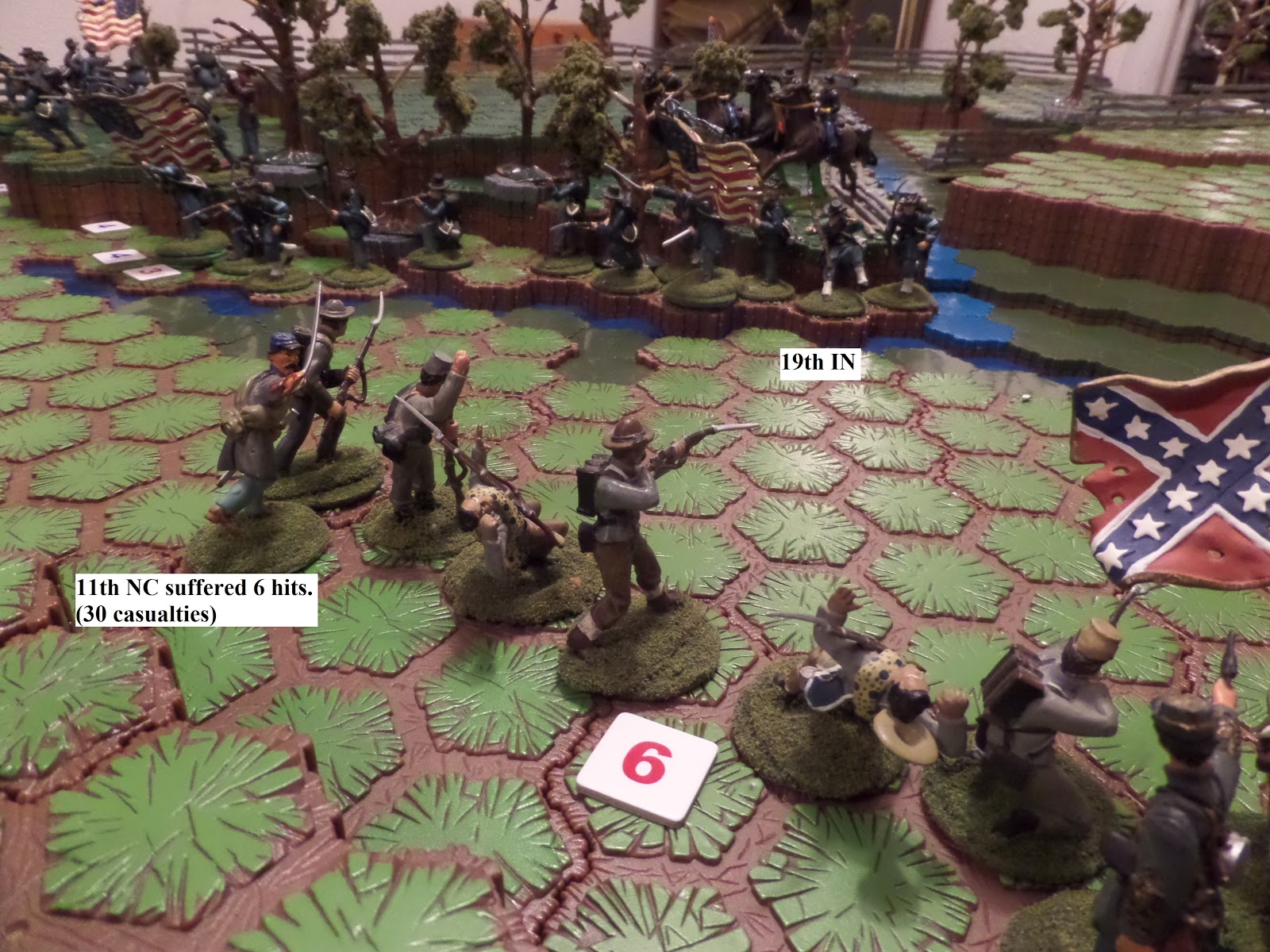
The left of the 19th Indiana fires into the left flank of the 11th North Carolina

Battlefield interpretation, miniature wargaming, and wring about an action are all interrelated. Wargaming on a small unit tactical level puts the gamer on the field. Walking the field helps the gamer understand the importance of line of sight and command control. Walking the field and gaming help the historians visualize what occurred on the field and helps with describing as clearly as possible the event as it actually occurred. What strikes our visitors the most about Antietam is how the ground changes so quickly and therefore affects their understanding of the battle. Every time I go out on the field, I learn something new and though provoking.

Thank you again for your time and patience. As always, I appreciate any and all constructive observations and comments.

In response to Stew, this is the proposed game chart. Player A is the one who wins the initiative.

The turn involves action and reaction. 

Friday, May 31, 2019

Turn 2 Wargaming Herbst Woods, July 1, 1863


I am shooting the final turn of this small scenario this week. There are five turns. The idea is to produce a sample game which the readers can download to create their own rules set. The beauty of miniature wargaming is that the players tweak the rules to meet the specific needs of their game. It is comparable to doing historical research where new information changes the original narrative.

Over the following month of so, I will be blogging in a more traditional manner by interrupting the flow of the game with "normal commentaries as well. I genuinely appreciate your patience in this process. My mind doe snot fire in any particular sequence at times and I want to provide the audience with a variety of commentaries.

Turn 2 Confederate initiative.


The 6d represent the Adjusted Range. The Confederate are red and the Federal white. 
Add caption


Close up of calculating officer casualties. Officer casualties are checked when a piece is lost.


The two wings did not collide therefore the right wing does not have to roll for a panic check.


Once again, thank you for reviewing this long entry. Your thoughtful and constructive observations and comments are always welcome.


Wednesday, May 22, 2019

Wargaming Herbst Woods Turn 1

What follows is photographic presentation of  my game rules "By the Left Flank!" This is Turn One. I figured it would be easier to introduce the rules as the game is played than in the traditional rule book format. As always, constructive questions and observations are always welcome. This game can be played solo or by two or more players at this small scale.


Add caption

The measuring sticks are made from wooden window blind slats.

My apologies for the typing error.


Turn 2 follows next week. I thank you for your patience because I am learning the photo editing as I go along. Again, I thoroughly appreciate your observations and comments.


Wednesday, May 15, 2019

Miniature Wargaming Herbst Woods in 54mm


At the request of a colleague and fellow miniature wargamer, I decided to recreate Herbst Woods at Gettysburg, July , 1863 for our next game. Using the excellent base maps which cartographer Stephen Stanley generated for my newest Gettysburg project, I developed an Heroscape version of the battlefield.

The Trees and fences are Marx reproductions. Unless otherwise noted, the figures are by Conte. 
Each hex represents 50 feet of terrain and each infantry piece, officers excepted, represent 50 men in two ranks with file closers. The two Confederate regiments are the 26th North Carolina and the 11th North Carolina. The Iron Brigade from left to right are the 19th Indiana. 24th Michigan, 17th Wisconsin, and 2nd Wisconsin. Interestingly enough, the length of the regimental lines are to scale according to the descriptions left by the veterans of the four regiments. Based upon the frontages and the actual western face of the woods, the 2nd Wisconsin would have to have faced north to secure the brigade’s right flank and still be covered by the woods.


The ravines are steeper in the model than on the contour map because it was physically impossible to reproduce them exactly with the Heroscape pieces The distinct ridgelines, however is to scale with the Stanley maps for the distance between each ridge.

The creek hexes represent the creek bans on both sides. It was not possible to make it to scale using Heroscape.


Movement can be anywhere from 1 – 9 inches (50-450 feet), which reflect lock step to the double quick. The flexibility of the rate allows the players to deduct distance from each move for ascending and descending contours, jumping of wading the creek and slogging through the marshy creek bottoms. (Gettysburg gets very soggy.) 
A deduction of 1 inch applies per layer of the Heroscape.


Over the next several blogs I intend to present my informal rules set, By the Left Flank! In stages. This is the introduction to the basics of the scale for movement and organization. Future posts will address Turn Sequence, Firing, Hand to Hand Combat, Casualty Recording, Skirmishers, Role of Officers. I intend to explain the game through annotated photographs as I play the game solo.

I thank you for your patience with this experiment and genuinely encourage constructive questions and observations.